Hole-in-the-Rock Landmarks and People

Hole-in-the-Rock Landmarks and People
Answers at bottom of the left column.
Showing posts with label Robinson. Show all posts

January 9, 2010

Holyoak, Henry and Sarah Ann Robinson

From HISTORY OF HENRY HOLYOAK By Minnie L. Carlile:
Henry Holyoak was born March 5, 1839, in Yardley, Worcestershire, England, the seventh child of George and Sarah Green Holyoak of that place. His brothers and sisters are: William, Mary, George, Anne, Sarah, Henry and Hannah.
Children on the trek: Alice Jane, Henry, John, Mary Luella, Eliza Hellen, Albert Daniel
The Holyoak family had joined the Church of Jesus Christ of Latter-day Saints June 24, 1841 and like all the saints, lived for the day they could accumulate enough money to come to America, sailing in February 1854, and landing April 1854. They came immediately on to Utah, arriving in October 1854. The trek across the plains was hard and also saddened by the loss of Mother Sarah and sisters Mary and Anne. Henry settled in Parowan, Utah, with his father and sisters. In 1863 and later he made three trips back East with ox-team for freight and immigrants.

In 1865 on January 29, he married Sarah Ann Robinson, daughter of English Immigrants. She was born in Nauvoo, Illinois December 22, 1842, and came to Utah with her parents settling in Paragonah. [Sarah Ann Robinson Holyoak, who was JR Robinson’s half sister.  His son JR Robinson Jr. was also called to San Juan.  Her mother & father were married on the ship to America in 1842, Alice Coupe Robinson died in Pottatattamie County, Iowa May 30, 1847, and left Sarah and her brother Richard.  J R Robinson Sr married her sister Jane, at his first wife’s request, who was traveling with them, on August 24, 1847, They had 15 children, including the two from her sister. ]


They later went to the temple when it was ready for sealings and had their work done. It is interesting to note that all their children have been married in the temples; also the big majority, if not all of their grandchildren.
Children of this union are Alice Jane (Thomson), Henry John, Mary Luella (Young), Eliza Ellen (McConkie), Albert Daniel, Richard James, and Sarah Ann. (died at 13 years of age).  James died at 8 years of age. The other five have contributed to the 29 grandchildren and over 200 great and great, great grandchildren.
(First five children were on the Hole in the Rock trail.)

When the church called colonizers for San Juan, the Henry Holyoak family were among those who were called from Parowan, 1879-80, (probably the 69th quorum of seventies) [According to J R Robinson's story, at the quarterly conference of the Parowan Stake, held Dec. 28 and 29, 1878 Holyoak was one of the  names called to serve as a missionary "to settle where directed."   Others who went from Paragonah were William Robb, James R. Robinson Jr,  James Dunton.]

Sarah Ann drove her own wagon most of the way. She had a bed in it as well as a stove to keep her young children comfortable, the baby being very young. Henry John and Alice Jane drove the livestock, (which consisted of about 100 head of cattle, a yoke of oxen and some horses, at the time they moved on to Moab). The calves were tied up at night and in the morning the dairy cows were milked. The milk put in the barrel churn on back of the wagon would, by night, supply the family with fresh butter as well as milk. Many others shared in these dairy products (Carlile History).

The four years spent on the San Juan were wasted so far as crops were concerned because the rising river ruined the farming land, also took out the water wheel and washed it to the other side of the river. This left them with no way to get water onto crops not washed away.
Researcher Ron McDonald then continues the pioneer story:
"The Holyoak family moved to Bluff for a short time, but much of the land at Bluff had been washed away also, and it seemed there was no place for them. They decided to accept the mission release, and search for a more hospitable location. This would be their seventh move in just over four years. The wagon they brought through the Hole-in-the-Rock had been their home, much of the past four years.

During October of 1884, the Holyoak family followed the tracks left by the eight wagons, which, just a few weeks earlier, had carried the Harriman and Davis refugees north. They camped for a few days east of Blue Mountain near where the town of Monticello is now located. They then continued their journey past the spot where the Old Spanish trail intercepted Coyote Wash and finally to the location now called Kane Springs. The old wagon broke a wheel, and they were stranded. This was probably the low point for the Holyoak family. They were out of food; the wagon had serious damage; and they really didn’t even know where they were going. Fortunately, they still had a few cattle left from the fine herd they had brought from Parowan.

Henry left his family at Kane Springs, and rode all the way to Castle Dale in search of food. This trip took two weeks and the family hunted and ate rabbits until his return. He had procured some pig feed, with the chaff, bran and all, mixed together, which was the only thing he was able to buy. Henry went to work repairing their wagon. Near the end of February, they arrived and pitched a tent at a place a little east of the present town of Moab.


Henry traded nine cows and ten steer to Lester Taylor for eighty acres of land in an area, which appropriately became known as Poverty Flats, and still carries the name to this day. They had found their permanent location and there would be no more moves other than local ones. Things gradually began to improve. The Holyoaks were among the first settlers in the area. Someone said they were the seventh family to settle in the area. They helped build the town of Moab.
Part of the Holyoak family at a cabin they called Batchelor’s Hall, in Moab 1898
The photograph was taken a number of years after the Montezuma episode. The location was between Mill Creek and Pack Creek at Moab.
Left to right: Henry Holyoak, Richard Leroy Holyoak-child being held by Hattie Elizabeth Lutz Holyoak, Mary Luella Holyoak Young, Marion Thomson-child behind dog. (The dog was named Bob), Eliza Ellen Holyoak McConkie-inside cabin, Alice Jane Holyoak Thomson- center of doorway, James and Henry Thomson-children in basket, Sarah Ann Robinson Holyoak, Gurtie Thomson, Robert Thomson -Notice curious object inside his shirt, Henry John Holyoak, ? Davenport.
==================

Henry was called to serve a mission to England, his son, Henry John, served a mission to the southern states and Florida, where he contracted malaria, but survived. Albert Daniel also served a mission.

McDonald found this intereting story: "The Holyoak history tells of the Indian friends they had made while living at Montezuma occasionally visiting them at Moab. There would be a happy reunion when they arrived, and Henry would kill the fatted calf and put on a feast. The friendship the Holyoak family had with the Indians was genuine. This is truly amazing, when considering the fact that just fifteen miles from the Holyoak place, there are graves of at least ten white cowboys, who were killed in a fight with those same Indians during the Pinhook War." 

Henry Holyoak was a counselor to Bishop Stewart, first Bishop of Moab Ward. Sarah Ann was counselor in the Relief Society and later became President. Sarah Ann died on November 20, 1921 at Moab. Henry died on January 23, 1926 at Ogden, Utah and was buried at Moab. They were wonderful pioneers, who lived valiant lives, facing all their tribulations and adversity with faith and patience. They left a very impressive posterity. More information

Henry John  Holyoak 1870-1960
Henry John (1870-1960)
This link shares his memories.  He was a young man at the time of the expedition. .
Desert Magazine 1961 August also has Holyoak information in it.

January 7, 2010

Lyman, Platte DeAlton and Adelia Robison

Platte DeAlton Lyman
Born: August 20, 1848 Platte River, Goshen, Wyoming
Died: November 13, 1901 in Bluff, San Juan, Utah and is buried there.
Parents: Amasa Mason Lyman and Eliza Partridge
Married: (1) Adelia Robison on May 18, 1867  (2) Annie Maud Clark in 1879
Children on the trek: Evelyn and Albert Robison came through the Hole in the Rock with them

Childhood
Platte De Alton Lyman was born in a wagon box on the east bank of the Platte River (Nebraska) on the morning of August 20, 1848. He was not the first child to have been born to Eliza Partridge Lyman in a wagon box. Little Don Carlos, Eliza’s first child, had been born in a wagon as she crossed Iowa with the Mormon Saints following their exodus from Nauvoo. Sadly, Don Carlos’s life was short, and Eliza buried him in the sandy banks of the Missouri River. The next summer, when the Saints began their westward trek to the Salt Lake Valley, Eliza was well into her second pregnancy, and soon little Platte was born, restoring gladness to her heart (1).

Platte’s childhood years were marked by poverty and want. His father, Amasa M. Lyman, was an Apostle of the Church at the time, and his church duties, as well as his responsibilities to his other wives and children, kept him away from Platte’s family much of the time. Eliza provided the best she could for her children’s temporal needs by spinning wool and making clothes. Spiritually, however, she nourished them with her unwavering faith in the truth of the gospel. Platte was deeply influenced by her example and testimony, and especially her love for the prophet Joseph Smith, whom she had known well. He was known to frequently say, both in public and in private, “I thank the Lord for such a mother.” (2) And In his later years, under adverse circumstances that might have destroyed the faith of others, Platte remained true to the Church thanks to the foundations of belief that had been laid within him by his mother.

Platte received less than three weeks of formal education his entire life (3). His mother taught him rudimentary skills, but was left to his own to study and become widely read. But most of his experience was gained and his character developed in the great outdoors, for he loved to be outside in the fresh air under a boundless sky. He loved dogs, and always seemed to have one at his heels. One dog of his had a peculiar interest in hunting skunks, a fetish which brought with it the obvious consequences. Yet Platte’s family tolerated the dog and the smelly skunks simply because they loved Platte so much (4).

For the first nine years of his life, Platte lived in Salt Lake City. His family moved briefly to Payson at that time, and then northward again to Farmington. As the years progressed, his family circle grew to include the families of two of his mother’s sisters, who had also become wives of Amasa M. Lyman. Thus the three sisters, and their children, lived together pretty much as one family, and as the oldest son among them, Platte felt the growing responsibilities of helping to provide for them all. He did so through hunting for food and plowing the fields. In fact, the only thing he remembered ever asking his father for was a yoke of oxen to help him with his work in the fields (5).

In 1863, Platte’s family moved to Fillmore, Utah. It was about this time that his father was excommunicated from the Church for preaching false doctrine. It was a bitter experience for Platte’s family, but his mother and her two sisters, also wives of the fallen Apostle, remained faithful to the Church and endured the humiliation brought on them with patience (6).

Marriage, Family and Missions
At the age of eighteen, Platte became engaged to Adelia Robison. At about the same time, he also received a mission call to Great Britain. He and Adelia were married by Brigham Young in Brigham Young’s office on May 18, 1867, and two days later Platte started eastward by wagon to begin his missionary labors. He became President of the London Conference, and served faithfully in his mission until his release on August 25, 1868. Upon returning home he was called to be a High Councilman in the Millard Stake. In 1874 he joined in the “United Order” with the church members of Oak City, but was called to serve a second mission in Great Britain the next year. This time he was assigned to the area of Nottingham, and became President of the Nottingham Conference until his release on October 25, 1876.

His return home was a joyful one. His children, Alton, Eliza and Evelyn, were more precious to him than gold, and eager to open the presents he had brought them. Sickness soon over took poor Alton, however, and within a month of Platte’s return home, the little boy died. Tragically, two more of Platte’s children passed away within the next three years, which brought great sorrow to the Lyman home and enticed Platte to consider relocating what was left of his family to Southern Utah. He was serving as the bishop of Oak City at the time he was called to be part of the San Juan Mission. He had also recently married a second wife, Annie Maud Clark, with whom he had become acquainted with in England. Unfortunately, Annie was never able to bear children, a sorrow to her all her life (7).

Hole-in-the-Rock
Platte De Alton Lyman set out for the San Juan on October 21, 1878. He was formally called as a Counselor to Silas Sanford Smith, the President of the San Juan Mission, on August 13, 1879, and received word of his appointment by letter a week later (8). When it became apparent to President Smith that the settlers would need additional supplies and funding in order to travel through the Hole-in-the-Rock, he set out for Salt Lake City to do the lobbying himself, as he had many ties to the legislature from twenty years of experience as a member of it. This left Platte, the “Assistant Captain” of the expedition, in charge of the wagon train for the majority of the arduous journey (9).

The journal that Platte kept during the trek is the most reliable, complete and informative source about the Hole-in-the-Rock expedition that exists today. In fact, it is the only record of the expedition written at the time, as all other accounts of Hole-in-the-Rock were put on paper years later (10). . . .

1. Albert R. Lyman, “Platte De Alton Lyman, Born on Platte River 20 Aug. 1848. Written by his son Albert Robison Lyman, Typed by Alice K. Hatch, Historian D.U.P. Manti Camp, Sanpete Co., (nd),” Daughters of Utah Pioneers, 2. Albert was Platte’s oldest living son, who greatly revered him, and also became a prolific historian and writer about the Hole-in-the-Rock expedition.

2. Ibid., 4. Albert noted, “The faith and hope and love of Eliza Partridge Lyman lived in her son Platte, not only in his heartfelt declarations that he thanked the Lord for such a mother, but he cherished her standards and held proudly to them wherever he went.” 5.
3. Ibid., 5.
4. Ibid., 7.
5. Ibid.,10.

6. Ibid.,11.
7. Ibid.,16-17.
8. David E. Miller, Hole-in-the-Rock; An Epic in the Colonization of the Great American West (Salt Lake  City: University of Utah Press, 1966), 14.
9. Ibid., 109

10. Ibid., 60.

Article by C.S.M. Jones LLC, Family Heritage Consulting for Hole in the Rock Foundation
==========

A complete copy of the journal is in Miller's Hole in the Rock. It has also been printed in
Blue Mountain Shadows: Volume 19 / Fall 1997 / pages 1-13 - Journal of Platte D. Lyman

Platte D. Lyman was called by the LDS Church to settle in San Juan County in 1879. He served as a leader in the expedition. Although called as an assistant to President Silas S. Smith, Lyman was often the active leader of the group, as Smith was often taking care of administrative duties in Salt Lake and other places. More...
After arriving in San Juan, he played an important role in the little community, serving as San Juan Stake President twice. He also presided over the LDS European Mission and was considered one of the Church's most eloquent speakers. He returned to Bluff in 1884 after being away for a time, and is buried in the Bluff Cemetery. He and his wife "Delia" reared a large family. Evelyn and Albert Robison came through the Hole in the Rock with them, and Mary, Lucretia, Edward , Caroline "Dollie" were born later (Saga of San Juan p 317)Albert R. Profile from San Juan Record.

Three other children: Platte DeAlton Lyman Jr, Eliza Adelia Lyman, and Lydia, died before they left Oak City.  Lyman's second wife, Annie Maude Clark Lyman, was born April 11, 1861, at Standwich, Northamptenshire, England. She is the daughter of Jonah Wilson Clark and Mary Smith Clark. She became a plural wife to Platte DeAlton Lyman October 24 or 25, 1880, in Logan, Utah. She had no children, but she and Platte had a five-year-old Swiss girl named Emma Lyman sealed to them in 1900. Annie died August 5, 1908 at Smithfield, Utah.

Lyman genealogy
Family Group sheet
Kumen's bio on Platte Lyman
Adelia Robison Lyman bio
Adelia Lyman home
Kumen Jones' tribute to Adelia Lyman
Early days in Blanding, Lymans help refugees
Kumen's writings about Albert R. Lyman


January 5, 2010

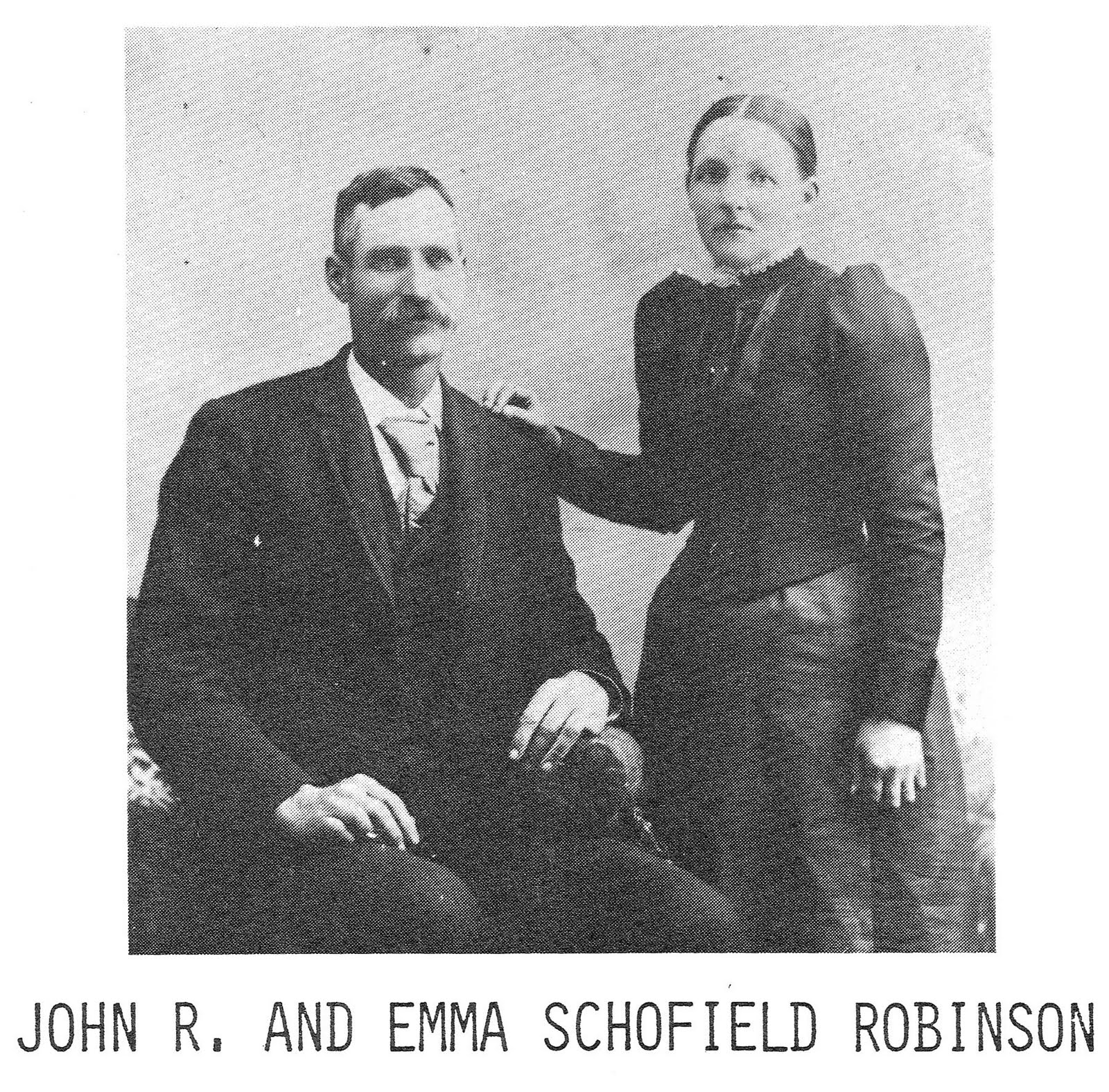
Robinson, John Rowlandson

John Rowlandson Robinson Jr.
Birth:  April 6, 1855 in Paragonah, Utah
Parents: John R. and Jane Schofield Robinson Sr.  
Married:  Emma Schofield Oct. 9, 1873, Salt Lake Endowment House.  They were both 19.
Death:  Feb. 9, 1939 in Paragonah, Utah.

Three references to him in Hole in the Rock by Miller: pp 59, 67, 162

Lula Bastian wrote the history provided to us by Judy Wade Cripps.  Judy can be contacted at  jcripps@accesswest.com

John R. Robinson Jr.  grew up in Paragonah.  He was the 5th of 15 children.  In 1855 his parents moved to the one-story fort.  One of his early school teachers was Mr. Decker.  He only received schooling during the winter months.  When he was ten he helped herd Lowder's cows and some cattle of his fathers up the dugway, to find feed, as they had no hay for them.  He was paid in red striped calico fabric, but his mother didn't think it was suitable for him.

John Rowlandson Robinson Jr.'s siblings and father

   His family moved to Panguitch for a short time, but troubles with the Indians there forced them back to Paragonah.  He started freighting to Pioche, in Nevada when he was 15, and that is how he earned enough money to get married.
    He met his future wife, Emma,  at a dance in Parowan.  After one of the dances he asked her if he could walk her home, but she refused.  She told her mother, "I am not going to go with that little John Robinson!"   John at the time was six feet tall, and eventually he must have risen in her esteem by the time he married Emma at age 19.  

When their first child Jane was a baby; they ranched out at Buckskin with Grandma Prothero, Hyrum Schofield, and one of John's best friends, James Dunton.  John started in the sheep business by renting the herd of his brother James, while he was on a mission, and by good management, became very successful, although at one time he only sold his wool for 4 cents a pound.

    Then in 1878 his life took a major turn.  At the quarterly conference of the Parowan Stake, held Dec. 28 and 29, his was one of the  names called to serve as a missionary "to settle where directed."  So in late October of 1879, he left with a company of 150 people and 100 wagons to settle the San Juan Country.  He took 15 head of cattle, all of which were lost before they reached their destination.  Others who went from Paragonah were William Robb, Henry Holyoak, and his friend, James Dunton. [Henry was married to  Sarah Ann Robinson Holyoak, who was JR Robinson’s half sister.  Her mother & father were married on the ship to America in 1842, Alice Coupe Robinson died in Pottatattamie County, Iowa May 30, 1847, & left Sarah & a brother Richard.  JR Robinson Sr married her sister Jane, at his first wife’s request, who was traveling with them, on August 24, 1847, They had 15 children, including the two from her sister. ]

     The winter of their trek was extremely severe. They went by way of Panguitch and through Escalante, building road as they went; and at times it almost seemed impossible to get through.  There were springs about every 10 miles across the desert, but when they could not travel that far, they were forced to use water found in holes in the rocks for camp water.

    John told of the difficulty they had in cooking beans in the hard spring water, and when the women asked him in surprise how he had been able to cook his beans, he told them he had used rain water.
There were only a few women in the company as he and many of the other married men had left their families behind.  At 50-mile Spring, one of these women, Mrs. Decker [Anna Marie Mickelsen Decker ] gave birth to a baby,  Lena Deseret Decker  who was born January 3, 1880 at Fifty-mile camp. They were fifty miles from the nearest settlement, one hundred miles from a doctor, and 150 miles from their anticipated home.  Both mother and child suffered no ill effects.  They camped at this spring on Christmas Day and held a dance around the campfire that evening.
    John was one of a group of men who scouted ahead for a place to build the road.  On one of these trips he found a turtle, colored with all the colors of the rainbow.  He tried to take it back to the company, but the colors faded when it died.

    Many of the group felt it would be impossible to build a road down through Hole-in-the-Rock, which was a hill of solid rock.  Several of the men wanted to turn back, but George Hobbs thought it could be done.  At this point Jens Nielson declared that the company must go on, whether "we can or not."  The majority voted to continue.  They camped at 50 mile Spring until the road down Hole-in-the-Rock was finished.  In some places a rut was made in the rock deep enough to hold one wagon wheel.  In other places, holes were drilled in the rock and pegs were inserted and covered with rocks an brush to make a foundation for a road [Uncle Ben's Dugway].  When it was completed, chains and ropes were attached to the wagons and as they were driven down the steep road, men and boys of the company controlled the wagons by holding back on the ropes and chains.

   The Hole-in-the-Rock road brought them to the banks of the Colorado River which was the next obstacle in their path.  They crossed the river with sort of a raft to carry their cattle and wagons across.  Here, one boy almost lost his life,but by the heroic work of the men, he was saved.  Soon they came to a lake where the women and children stayed until they made a road to a place they called The Cedars"
   John told how one night when it was bitter cold, they did not cook a hot meal for supper, but instead ate dried apples and only drank water.  They became very ill during the night, and after that, always cooked, no matter how cold it was.
    During the time they were building "The Cedars" road and after it was completed they had no trouble finding water for camping as they had plenty of snow to melt.  After traeling about 15 miles beyond the road, they came to the San Juan River on April 6, 1880, which was John's 26th birthday.  Here they gathered the rest  of the company and drew for lots in Bluff.
      They worked for two months building a dam across the river to get their water for irrigation.  John never developed the lot he receied in the drawing.  Two months after arriving, in June, John and some of the other men went back to the Colorado where they met men with provisions and merchandise sent out by the Church from Salt Lake.  They men paid for the supplies with labor and received credit for work they had done on the road.  John got a pair of boots.
  John came home to Paragonah in October of 1880, after a year's absence, making the return trip in only three weeks, compared to 6 months it took going to Bluff.  He had intended to return to the San Juan with his wife and four small children, but his father gave him five acres of land to remain in Paragonah.  While he had been on the San Juan Mission, his uncle Hyrum Scofield, farmed his land for him.

    He was interested in the Co-op cattle and sheep herds, and spent much of his time in Bear Valley looking after cattle and working on the sawmill.  He was instrumental in getting the Paragonah water system started and successful in all of his business ventures, because of his hard work and good judgement.  He also served as water captain for the field company, and in other responsibel positions.  He was director of the Bank of Iron County from the time it was established until it closed.  He held the position of High Priest in the LDS Church.
    He and his wife Emma were the parents of 10 children: Emma Jane born 1874; Mary Isabell born 1875; Margaret Alice born 1877; John Jr. born 1879; Hyrum born 1882; Sarah born 1884; Arnold born and died in 1887; Lula born 1888; Ellis born 1891; and Joseph born 1894.  Nine of these children lived to maturity, married and had families.  In 1957 he had 160 living descendants into the fourth generation, and many more great-great-grandchildren.
    John had an excellent constitution of body.  He was tall but well set and strong.  He had a mechanical genius and was very handy in the use of tools, but his great excellece lay in good understanding and sound judgement.  He was a self-educated man through extensive reading, which gave him an exceptionally good store of knowledge.  He liked very much to sit and converse with friends and neighbors on current events.
He died Feb. 9 1939 after suffering years from a heart ailment, leaving 8 sons and daughters, two having preceded him in death.  He had 33 grandchildren, and 44 great-grandchildren to mourn his passing.